
 By
By IT’S A SAD DAY whenever one of the last remaining Apollo astronauts passes away, especially when it is one of the few who went to the Moon.
Bill Anders, who died last week at the age of 90, was one of those guys, even if he never set foot on another celestial body.
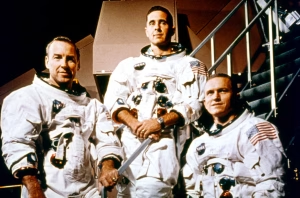
Although he was never a household name, Maj. Gen. (ret.) William “Bill” Anders, is known for a great many things, but two of them jump out above all:
- He was one of the three astronauts on Apollo 8, “the first crewed spacecraft to leave Earth’s gravitational sphere of influence, and the first human spaceflight to reach the Moon.”
- He took the famous color photo of the “Earthrise” seen from lunar orbit as Apollo 8 circled the Moon on Christmas Eve, December 1968.
The great impact of Apollo 8
THE FLIGHT OF APOLLO 8 was a huge triumph at the end of a pretty terrible year that included the assassinations of the Rev. Dr. Martin Luther King Jr. in Memphis, and Robert F. Kennedy Jr. in Los Angeles after he won California’s Democratic presidential primary.
NASA Administrator Bill Nelson, a former U.S. Senator who also flew in space on the Space Shuttle Columbia in 1986, had this to say on the passing of Bill Anders:
“In 1968, as a member of the Apollo 8 crew, as one of the first three people to travel beyond the reach of our Earth and orbit the Moon, Bill Anders gave to humanity among the deepest of gifts an explorer and an astronaut can give. Along with the Apollo 8 crew, Bill was the first to show us, through looking back at the Earth from the threshold of the Moon, that stunning image – the first of its kind – of the Earth suspended in space, illuminated in light and hidden in darkness: the Earthrise.
As Bill put it so well after the conclusion of the Apollo 8 mission, ‘We came all this way to explore the Moon, and the most important thing is that we discovered the Earth.’
That is what Bill embodied – the notion that we go to space to learn the secrets of the universe yet in the process learn about something else: ourselves. He embodied the lessons and the purpose of exploration.”
 That famous quote from Bill Anders — “‘We came all this way to explore the Moon, and the most important thing is that we discovered the Earth.” — is a reminder of how surprised and awestruck the Apollo 8 crew, that included flight Commander Frank Borman and Command Module Pilot Jim Lovell, reacted when they became the first people to ever view our home planet from lunar orbit.
The first to see an Earthrise
IT WAS ONE OF MANY firsts for the crew of Apollo 8, a crew led by flight Commander Frank Borman as well as Jim Lovell (made famous when he was portrayed by Tom Hanks in the film Apollo 13), and Bill Anders.
Here’s how the Boston Globe‘s Jeff Jacoby explained what those three astronauts saw:
“As they circled the moon with their onboard camera aimed at the surface below them, the crew described what they were looking at.
‘The moon is essentially gray, no color,’ Lovell said. ‘Looks like plaster of Paris, or sort of a grayish deep sand.’ Borman characterized the scene as ‘vast, lonely, forbidding . . . a great expanse of nothing that looks rather like . . . clouds of pumice stone.’
During the fourth orbit around the moon, Borman rotated the spacecraft so that its nose tilted back toward Earth. Suddenly, through the ship’s small windows, they saw a sight that imbued a whole new level of meaning to what they were doing: The Earth was rising above the lunar horizon.
‘Oh my God,’ Anders gasped, ‘Look at that picture over there!’
‘What is it? asked Borman.
‘The Earth coming up. Wow, is that pretty!’
Levitating above the bleak and barren lunar surface was the world they had come from. They were looking at an ineffably delicate marble of blue and white, floating alone in the darkness, home to everyone and everything they or anyone had ever known — ‘the most beautiful, heart-catching sight of my life,’ Borman later said, ‘one that sent a torrent of nostalgia, of sheer homesickness, surging through me.’
He was seeing the Earth, Borman thought, the way God himself must see it.”
“God bless all of you … on the good Earth”
Wikipedia details how the Apollo 8 astronauts photographed the Earthrise, but it is the color photo by Bill Anders that remains as the quintessential image of our home planet as first seen by people of the Earth circling the distant Moon above.
The Apollo 8 crew is also remembered for their Christmas Eve television broadcast from lunar orbit to an estimated 1 billion people on Earth. As Wikipedia describes it:
“As they rounded the Moon for the ninth time, the astronauts began the second television transmission. Frank Borman introduced the crew, followed by each man giving his impression of the lunar surface and what it was like to be orbiting the Moon. Borman described it as being “a vast, lonely, forbidding expanse of nothing … Then … Bill Anders said that the crew had a message for all those on Earth.
Each man on board read a section from the Biblical creation story from the Book of Genesis. Borman finished the broadcast by wishing a Merry Christmas to everyone on Earth. His message appeared to sum up the feelings that all three crewmen had from their vantage point in lunar orbit. Borman closed the broadcast by saying, “And from the crew of Apollo 8, we close with good night, good luck, a Merry Christmas, and God bless all of you — all of you on the good Earth.”
As the Boston Globe‘s Jeff Jarvis added:
“The astronauts’ choice of a (Biblical) text for their final broadcast had come as a complete surprise to NASA, Robert Kurson observed in his book ‘Rocket Men,’ a thrilling account of the Apollo 8 saga. The specialists on duty in Houston heard it when the rest of the world heard it, and when the transmission ended, many were overcome with emotion.
‘Inside Mission Control, no one moved,’ Kurson wrote. ‘Then, one after another, those scientists and engineers in Houston began to cry.’
In the days that followed, the world couldn’t stop talking about what Apollo 8 had achieved. The New York Times editorialized that it had been ‘the most fantastic voyage of all times.’ In seven months it would be eclipsed by an even more fantastic voyage — the Apollo 11 moon landing — but as 1968 came to an end, it was far and away the greatest thing imaginable.
Time magazine tore up its planned Man of the Year issue on ‘The Dissenter’ and rushed to change it to ‘Astronauts Anders, Borman, and Lovell.’ Congratulatory messages poured in from everywhere, from renowned world leaders and celebrities to anonymous admirers.”
HERE’S THE SAD PART: Although most everyone has seen the famous Earthrise photo, few people today know that Bill Anders was the person who took it during his only flight into space.
Although the 1960s were pretty turbulent — 1968 in particular — the space race to beat the Soviet Union to the Moon was a goal embraced by a great many Americans, and helped to pull us together.
Apollo 8’s voyage to the Moon was a big part of that, and it was Bill Anders beautiful photo of the Earthrise that reminded all that we are inhabitants of a small and fragile planet that is our home.
That’s why what Bill Anders said — “We came all this way to explore the Moon, and the most important thing is that we discovered the Earth” — continues to resonate today, perhaps even more than it did in 1968.
A rich life beyond a trip to the Moon
BUT AS IMPORTANT as Apollo 8 and the Earthrise photo are, Bill Anders did a great many other things over the course of his long life.
- He was born in Hong Kong, the son of an American Naval officer who served on the Yangtze River Patrol.
- In 1955, Bill graduated from United States Naval Academy at Annapolis as an electrical engineer.
- He was commissioned into the U.S. Air Force, earning his pilots wings in 1956.
- As an Air Force pilot, he served in all-weather fighter interceptor squadrons in California and later in Iceland, where he participated in early intercepts of Soviet heavy bombers who were then challenging America’s air defense borders.
- In 1958, Anders entered the graduate studies program at the U.S. Air Force Institute of Technology, specializing in nuclear engineering while also taking a night school course in aeronautical engineering from Ohio State University. He graduated with honors in 1962.
- He was chosen by NASA for the astronaut corps in late 1963, flew to the Moon in Apollo 8, was appointed by the President to be the Executive Secretary of the Aeronautics & Space Council.
- In 1973, President Nixon appointed Anders to the Atomic Energy Commission, where he was made commissioner responsible for all civilian and military nuclear power R&D. With the breakup of the AEC, he was made the first chairman of the Nuclear Regulatory Commission.
- And from 1975 to 1977, Bill Anders served as the U.S. Ambassador to Norway.
An adventurous spirit until the very end
The BBC noted that, “The loss of Apollo 8 astronaut William ‘Bill’ Anders in June 2024 came just weeks after the death of Thomas Stafford, who commanded both Apollo 10 in 1969 and the Apollo-Soyuz Test Project in 1975.”
But the BBC went on to add this important insight:
“That Anders was reportedly flying the aircraft in which he died, at the age of 90, is evidence the adventurous spirit that took him into space had not been dulled by age.“
Anders died June 7 when a small plane he was piloting alone crashed into the water northwest of Seattle. A search crew recovered his body from the area of the crash, according to the U.S. Coast Guard. He was 90 years-old.
NASA’s Bill Nelson probably described Maj. Gen. (ret.) William “Bill” Anders best:
“At every step of Bill’s life was the iron will of a pioneer, the grand passion of a visionary, the cool skill of a pilot, and the heart of an adventurer who explored on behalf of all of us. His impact will live on through the generations. All of NASA, and all of those who look up into the twinkling heavens and see grand new possibilities of dazzling new dreams, will miss a great hero who has passed on: Bill Anders.”


